

A torn cruciate ligament is one of the most common orthopedic injuries we see in dogs, and the conversation around it tends to skip past the most useful question: why does this happen, and what does a complete treatment plan actually look like? The answer covers more ground than people expect. CCL tears are usually degenerative rather than traumatic, certain breeds and body types carry meaningfully higher risk, and the best outcomes come from pairing the right surgical procedure with structured rehabilitation that rebuilds strength after the structural fix.
Stack Veterinary Hospital offers all three pieces under one roof: complete in-house diagnostics, orthopedic surgery performed by a board-certified veterinary surgeon, and a dedicated rehabilitation program with an underwater treadmill. The same team that diagnoses your dog’s knee guides the surgical decision, performs the repair, and walks the knee back to full function. If your dog is limping or facing a cruciate decision, contact us and we will work through the plan together.
CCL Tears: The Essentials
- Most CCL tears are degenerative, not the result of a single bad moment, and that explains why they are so common.
- Breed, weight, and conformation all influence the risk meaningfully.
- Surgery is the right call for most medium and larger dogs, since the knee cannot restabilize itself.
- Rehab is not optional for the best outcomes, including underwater treadmill therapy when available.
- In-house care from diagnosis to recovery keeps your dog with one team through the whole process.
What Is a CCL Tear, and Why Does It Happen?
The cranial cruciate ligament, the canine equivalent of the human ACL, sits inside the knee and prevents the shin bone (tibia) from sliding forward against the thigh bone (femur) during normal movement. When it tears, the joint becomes unstable, and every step grinds the cartilage and drives inflammation.
The surprising part for most families is that canine CCL tears are usually not the dramatic single-moment injury people associate with the human ACL. The vast majority are degenerative, meaning the ligament has been weakening for months or years before it finally fails during something as ordinary as jumping off the couch. This is why dogs who tear one CCL frequently tear the other within a year or two, since the same factors that weakened the first ligament are usually still weakening the second.
Several factors raise the risk:
- Labrador Retrievers, Rottweilers, Newfoundlands, Boxers, English Bulldogs, Mastiffs, and German Shepherds carry meaningfully higher rates than the average dog. A few small breeds, including Bichons and some terriers, also show elevated rates.
- Body weight. Overweight dogs tear CCLs at much higher rates than lean dogs of the same breed, since every extra pound increases the load on the ligament with every step.
- The slope of the top of the tibia (tibial plateau angle) affects how much shear force the ligament has to resist with every step. Dogs with a steeper slope are at higher risk regardless of breed.
- Most CCL tears happen in middle-aged dogs between 4 and 10 years old, after the ligament has had time to degenerate.
- Activity pattern. The “weekend warrior” dog who is sedentary during the week and runs hard on Saturday tears CCLs at higher rates than dogs with steady moderate conditioning.
- Existing knee problems. Dogs with patellar luxation, prior knee injuries, or chronic stifle inflammation are at higher risk because the joint is already not moving normally.
When a cruciate ligament injury does happen, it is occasionally truly traumatic, like a dog slipping on ice or landing badly off a high jump, but even in those cases the ligament was often already partly compromised.
What Are the Symptoms of a Torn CCL?
The signs of a CCL tear vary by how complete the injury is. A full tear announces itself, usually with a dog suddenly holding the leg up off the ground after exercise or a jump. A partial tear can be much quieter, producing intermittent lameness that improves with rest and then returns, often brushed off as something minor until it progresses.
What to watch for:
- Hind-limb limping or toe-touching that may be sudden or gradual, complete or intermittent.
- Difficulty rising from a lying or sitting position, especially after a nap.
- Sitting with the leg out to the side rather than tucked normally under the body, often called a positive sit test.
- Visible swelling on the inside of the knee, where the joint capsule has thickened.
- Stiffness after rest that may improve with movement, only to worsen again later.
- Reduced interest in stairs, jumping, or long walks that used to be enthusiastic.
The instinct to watch and see is understandable, but a CCL tear that resolves with a few days of rest is usually a partial tear that will return, often worse. Bringing your dog in when the limp first appears is what catches the injury early, when the meniscus is more often intact and the joint has had less time to develop arthritis.
How Is a CCL Tear Diagnosed?
Diagnosis combines a hands-on orthopedic exam with imaging. On exam, the key finding is abnormal forward movement of the shin bone, the cranial drawer sign, which confirms the joint is unstable. A second test, the tibial compression test, looks for the same instability through a different mechanical maneuver. Most dogs will need sedation for these tests, since a tense or painful dog will mask the abnormal motion by tensing their muscles around the knee.
From there, imaging fills in the rest:
- X-rays: show the bone, the joint capsule, and how much arthritis has already formed. X-rays also let our surgical team measure the tibial plateau angle, which guides surgical planning.
- MRI: reserved for the complex cases where the picture is unclear, particularly when meniscal damage or unusual ligament patterns are suspected.
Our in-house diagnostic capabilities handle the workup for diagnosing the issue and preparing your dog for surgery if needed.
What Happens If a CCL Tear Goes Untreated?
This is the question that determines whether to act. The honest answer is that a torn CCL does not resolve on its own, the knee does not restabilize without treatment, and the consequences of leaving it untreated accumulate predictably.
Unstable joints continue to grind, and the arthritis that follows is faster and more severe than what we see in surgically treated dogs. The joint capsule thickens with scar tissue as the body tries to compensate, which limits range of motion permanently. The meniscus, a small cushion of cartilage inside the knee, often tears as a secondary injury in a chronically unstable joint, adding pain and complicating any later surgery. Muscle in the hind end wastes quickly because the dog is not loading the leg normally, and that lost muscle is much harder to rebuild later than to preserve now.
The other leg matters too. As the injured side compensates, the opposite knee bears extra load, and roughly 40 to 60 percent of dogs who tear one CCL tear the other within one to two years. Waiting tends to mean treating two knees instead of one.
Is Conservative Management Ever the Right Choice?
Conservative management, meaning strict rest, anti-inflammatory medication, and rehabilitation without surgery, has a real place but a narrow one. It tends to be reasonable for very small dogs (generally under 20 to 30 pounds), where the lower mechanical forces sometimes let scar tissue stabilize the joint enough for comfortable function. It is the appropriate choice for dogs who cannot safely undergo anesthesia because of significant health concerns. And it can be the kindest path for advanced-age or comfort-focused situations where a long surgical recovery does not fit the dog’s broader picture.
For a healthy, active dog of any real size, though, conservative management usually means accepting a joint that will stay unstable, which is a legitimate decision in some circumstances but should be made with eyes open. We will be candid with you about which group your dog falls into.
What Are the Surgical Options for a Torn CCL?
When surgery is the right path, two procedures handle the large majority of cases. They take different routes to the same goal of a stable knee.
| Feature | TPLO | Extracapsular repair |
| How it works | Reshapes the top of the tibia so the CCL is no longer needed | A heavy suture outside the joint takes over the ligament’s role |
| Best for | Medium, large, and giant or active dogs | Smaller, calmer dogs, often under about 40 pounds |
| Bone involved | Yes, a precise cut and repositioning of bone | No bone cut; a soft-tissue repair |
| Long-term outcome | Strong, durable return to function for active dogs | Good for light dogs, less reliable for heavy or athletic ones |
TPLO is the most common choice for medium and larger dogs and consistently produces the best long-term outcomes. The procedure reshapes the top of the tibia so the joint becomes mechanically stable without the need for the torn ligament, and roughly 90 to 95 percent of dogs return to comfortable function with two decades of published evidence behind the technique. Extracapsular repair places a heavy suture outside the joint that mimics the ligament’s role, and it is an excellent fit for the right dog, typically a smaller and calmer one. A third option, tibial tuberosity advancement (TTA), works on a similar bone-geometry principle to TPLO and suits certain dogs.
Why It Matters That Surgery and Rehab Happens Here, In-House
A defining feature of Stack Veterinary Hospital is that orthopedic surgery, including TPLO and other cruciate repairs, is performed in-house by a board-certified veterinary surgeon. After surgery, our certified rehabilitation practitioner develops a personalized plan for your dog with all the tools needed right here in our hospital.
Most practices that offer general medicine and surgery refer cruciate repairs to specialty surgical hospitals, which means a dog is diagnosed in one place, transferred to another for the procedure, and returned for follow-up. Rehab is provided in yet another facility, meaning more handoffs and medical record transfers. At Stack, the same team that diagnoses your dog’s knee plans the surgery, performs it, manages the post-operative care, and runs the rehabilitation. Your dog is in a familiar place with familiar people throughout, and the team building the rehab plan works directly with the team in the operating room and knows exactly what was done.
The clinical advantages of an in-house board-certified surgeon include the specialist-level expertise needed for advanced procedures like TPLO, modern surgical equipment matched to orthopedic work, anesthesia protocols and monitoring tailored to longer orthopedic cases, and integrated pain management that begins before the procedure and continues seamlessly into recovery.
What Does CCL Rehabilitation Involve?
Surgery solves the mechanical problem: it makes the knee stable again. What it cannot do on its own is rebuild the muscle that wasted while your dog was limping, restore the joint’s range of motion, or retrain your dog to trust and load the leg again. That is the work of rehabilitation. For dogs who aren’t undergoing surgery, rehab is still a critical part of their recovery.
Without it, dogs tend to favor the leg long after the repair has healed, which leaves them weak on that side, stiff in the joint, and more likely to overload the other knee. With a structured plan, the same dog rebuilds strength evenly, regains comfortable motion, and returns to full activity with a more durable result. The surgery buys the opportunity; rehab is how you cash it in.
Check out our videos for how to perform at-home exercises for your dog after surgery and how we provide rehab at Stack:
- Phase 1 and 2– passive range of motion, heat, and bicycling
- Phase 3 to 5– weight shifting, side stepping, sit to stand, and cavalettis
- Laser Therapy– for speeding healing and decreasing inflammation
Professional rehabilitation programs consistently improve both the speed and quality of recovery, which is why we keep that capability in-house rather than leaving the second half of treatment to chance at home.
Why Is Underwater Treadmill Therapy So Valuable?
One of the most useful tools in canine rehabilitation is the underwater treadmill, and Stack offers it as part of the rehabilitation program. The science behind it is straightforward: water buoyancy reduces the dog’s effective weight on the joints, allowing them to walk and exercise with far less load than dry-land work produces, while the water resistance simultaneously strengthens muscle through the entire range of motion.
The importance of water therapy in a rehabilitation program shows up in several ways for cruciate recovery specifically:
- Earlier weight-bearing. A dog who could not safely take a normal-loaded step on dry land can walk in the water weeks earlier, which prevents muscle wasting and restores normal movement patterns.
- Controlled progression. Water depth and treadmill speed are adjusted precisely, so the load on the repair can be increased gradually and measurably.
- Improved range of motion. The warm water relaxes muscles and supports the joint through fuller movement than the dog would tolerate on land.
- Better cardiovascular and muscular conditioning during a period when traditional exercise is restricted.
- Cleaner gait retraining. The forward-walking pattern in water is more even and rhythmic than what dogs default to when they are guarding a sore leg, which helps re-establish normal movement habits.
For TPLO recovery and other major orthopedic procedures, underwater treadmill sessions are often the difference between a dog who returns to full athletic function and one who plateaus at “comfortable but not the same.”
How Long Is Recovery, and What Should I Expect?
Most dogs bear some weight within days and walk comfortably within four to six weeks, but full return to pre-injury function generally takes four to six months. The trajectory is steady rather than dramatic, and it depends heavily on following the staged plan rather than rushing the leg back into action. We check progress at scheduled rechecks and clear each step up in activity, so the increases are earned rather than guessed at. The strongest recoveries usually come from families who treat the slow, controlled middle weeks as the real work, not a holding pattern.
What Happens If You Rush the Recovery?
The biggest setbacks come from doing too much too soon. In the first weeks the bone or repair is still healing and the surrounding tissue is fragile, so a single off-leash dash, a jump onto the couch, or a slip on a slick floor can strain or even fail the repair and send you back to the beginning. Rushing also undermines the steady muscle rebuilding that rehabilitation is designed to produce, leaving the leg weak and the dog reluctant to load it.
If your dog treats a leash like a starting gun, plan ahead for those weeks with extra confinement, mental enrichment, or a short course of calming medication, rather than hoping a high-drive dog will simply settle on their own.
How Do You Support Recovery at Home?
Home is where most of the recovery time actually happens, and the early weeks of crate rest are the hardest part. The first two weeks need a few specific things on hand:
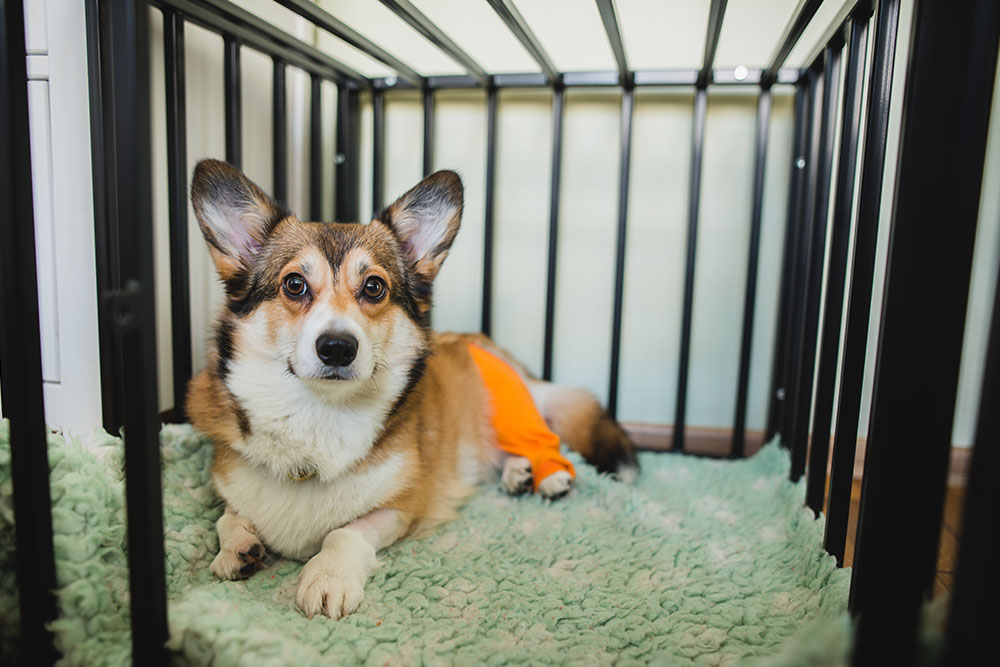
- A calm crate setup: a social, visible spot, with frozen food puzzles and gentle scent games to keep a restless dog occupied without stressing the joint.
- An e-collar or recovery cone protects the incision in those first two weeks; if your pet can still reach the incision or the cone is impossible, a lick sleeve is a nice addition.
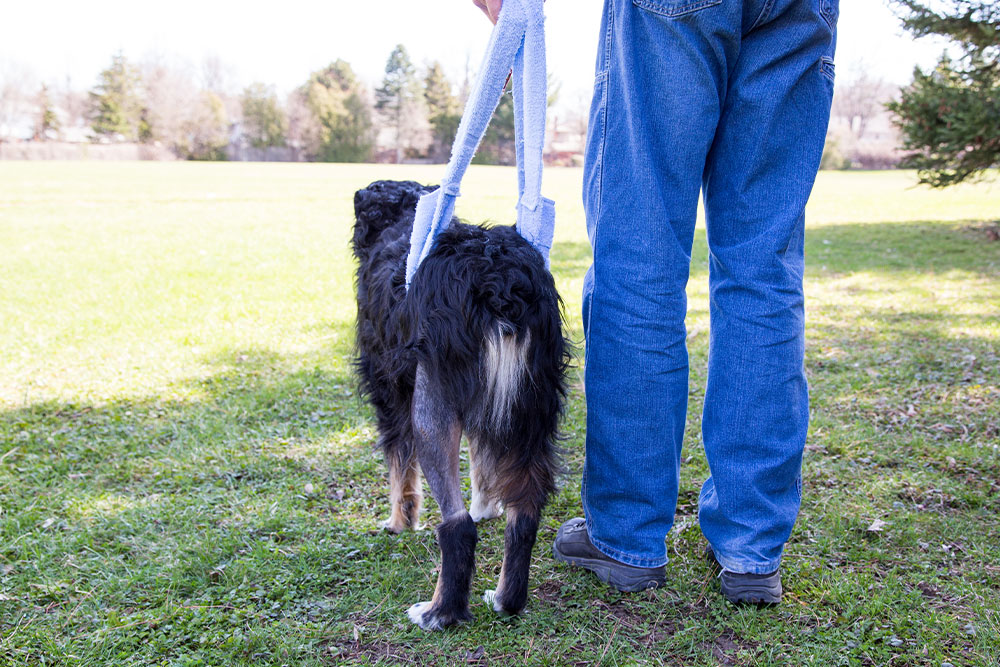
- Support harnesses make getting outside safer for a wobbly dog, and our pharmacy carries lifting harnesses that can help you balance your pet as they recover.
Past the recovery period, the work shifts to long-term joint protection that helps both knees:
- Traction at home: rugs or runners on slick floors keep the recovering knee from skidding mid-stride.
- A real warm-up and cooldown before and after activity helps prevent stiffness and injury.
- Weight control: the single highest-leverage protection for any dog with a knee history, since every extra pound multiplies the load on both stifles.
- Joint support through omega fatty acids and hip and joint supplements where they fit the plan.
Our wellness care visits build that long-term maintenance into your dog’s routine so the gains do not slip back.
Frequently Asked Questions About CCL Tears and Treatment
How Long After Surgery Before My Dog Walks Normally?
Most dogs are putting some weight on the leg within days and walking comfortably within four to six weeks, with full return to function over four to six months. The pace depends on following the staged rehab rather than rushing, and we confirm each step at rechecks before clearing more activity.
Will My Dog Get Arthritis Even With Surgery?
Usually some arthritis is already present, because the joint was unstable before diagnosis. Surgery and good rehab dramatically slow the progression compared with leaving the tear untreated, though they do not undo existing damage. Lifelong weight control, conditioning, and joint support keep most dogs comfortable and active for years.
Can My Dog Tear the Other CCL?
It is a real risk. Roughly 40 to 60 percent of dogs who tear one CCL go on to tear the other within one to two years, partly because that leg carried extra load during recovery and partly because the same risk factors that affected the first knee are still in play. Keeping your dog lean, conditioning steadily, and finishing rehab fully all lower the odds, and we watch the other knee at rechecks.
Do I Have to Go to a Specialty Hospital for TPLO?
Not when your primary veterinary hospital has a board-certified surgeon on staff. Stack performs TPLO and other orthopedic surgeries in-house, so families avoid the back-and-forth between a primary practice and an outside surgical center. Your dog is in a familiar place with familiar people from diagnosis through recovery.
What If I Can’t Afford TPLO Surgery?
Talk with us before ruling anything out. For some smaller dogs an extracapsular repair is both appropriate and less costly, and our payment plan options can spread the cost of care. We would rather find a workable path to treating the knee than have a dog live with a chronically painful joint.
Is At-Home Rehab Enough, or Does My Dog Need Professional Therapy?
Diligent at-home rehab carries a lot of dogs through recovery well, especially for straightforward cases and committed families. Professional rehabilitation, particularly with underwater treadmill therapy, adds structured strengthening and modalities that speed recovery and improve the final result, which matters most for large, active, or athletic dogs and for any dog whose progress stalls. We help you judge which level of support fits your dog.
One Practice, One Team, Through the Whole Recovery
A torn cruciate is best treated as a single plan with three phases: an accurate diagnosis, a treatment plan matched to your dog, and rehabilitation that rebuilds the leg back to strength. Dogs who get all three, with continuity through one team, return to comfortable and active lives, and careful long-term joint care protects them for years afterward. The continuity matters as much as the components, since the team building the rehab plan was part of the surgical plan and knows exactly what your dog needs at each step.
If your dog is limping or you are weighing a cruciate decision, request an appointment or contact us.
Our veterinarians and care team will guide every step, from the diagnostic workup through the surgical plan and the staged rehabilitation that follows.


Leave A Comment