


The mobility aid that helps a senior dog or cat most depends less on the number of birthdays and more on how far the weakness has progressed. In the early stage, when the main problem is slipping on smooth floors or balking at stairs, traction help such as paw grips, non-slip socks, and well-placed rugs is usually enough. As the hind end weakens, a support harness gives you a literal handle to steady your pet through stairs, car rides, and bathroom trips. When the rear legs can no longer bear weight, a wheeled cart can restore genuine independence. Behind every stage sits the same truth: a pet who is slowing down usually has a treatable condition such as arthritis, disc disease, or a nerve problem, and the sooner it is identified, the longer your pet stays on their feet.
At Stack Veterinary Hospital in Syracuse, we start with the question a device cannot answer: what is actually causing the slowdown. A hands-on exam and in-house X-rays help us narrow down whether arthritis, disc disease, or a nerve problem is driving it, and that answer decides whether traction, a harness, or a cart fits best. From there, rehabilitation with our certified rehab practitioner builds on the workup with hydrotherapy and drug-free laser therapy for sore joints, so the device supports a body that is also getting stronger. If your dog or cat has begun slipping on the floors or hesitating at the stairs, request an appointment and we will work out which stage your pet is in and what will genuinely help.
Start Here: Matching the Aid to the Stage
- Slowing down is usually a signal rather than a verdict, and arthritis, disc disease, and nerve problems are all treatable when we catch them early.
- The right aid depends on the stage, with traction and home tweaks early, a support harness in the middle, and a wheeled cart once the rear legs give out.
- The underlying diagnosis shapes the whole plan, so the first step is figuring out what changed and why, not grabbing a product off the shelf.
- A device is only one piece, because pain control, weight management, and rehabilitation do just as much as any harness or cart.
Is My Senior Pet Just Slowing With Age, or Is Something Treatable?
Most of the time, a stiff, slower senior pet isn’t simply running out of birthdays. What families chalk up to age alone is usually osteoarthritis in dogs and cats, a manageable condition rather than an inevitable part of getting old.
There’s one distinction worth learning to spot at home, because it changes the whole plan. A pet who is stiff, slow to rise, and reluctant on stairs is usually telling you something hurts. A pet whose paw folds under and stays folded, or whose back legs cross or scuff, is telling you the nerves aren’t reporting where the foot is. The first points toward arthritis and pain control. The second points toward the spine and deserves a prompt neurologic exam. Plenty of senior pets have some of both, which is another reason the device comes second.
Support that starts early, while a pet still has muscle and confidence, heads off the falls and awkward compensating that speed the decline. So the first move is never a product but an honest look at what changed and why, which usually means a full diagnostic workup to separate arthritis from a disc or nerve problem.
How Do I Know Which Stage My Pet Is In?
Mobility loss tends to move through recognizable stages, and the right support shifts along with it. What helps a pet who merely slips on the floor isn’t what steadies one whose rear legs have quit, so it’s worth knowing which stage you’re in and which is likely next.
| Stage | What you tend to see | Support that fits |
| Early | Stiff after a nap, slipping on floors, slower on stairs | Traction aids, home adjustments, joint support |
| Moderate | Needs a boost to rise, tires on walks, wobbles in the rear | Support harness, pain control, rehabilitation |
| Advanced | Can’t reliably stand or push off with the rear legs | Mobility cart, full-body harness, close monitoring |
Not every pet moves through these in order, and some conditions skip ahead fast, so treat the table as a planning guide rather than a fixed timeline.
What Helps When a Senior Pet Starts Slipping and Stiffening?
In the early stage the legs still work fine, and the real problems are grip and comfort. Traction aids and a few home changes usually carry a senior pet through, and the whole picture reads like ordinary aging, which is exactly why it’s so easy to miss.
Rubber toe grips slip over a pet’s nails to restore traction on tile, hardwood, and the other slick floors where aging paws scrabble for a hold. Grippy booties do the same job for indoor and outdoor use and add a little protection for toes that drag, which earns its keep once Syracuse sidewalks turn to ice and packed snow. Cold mornings deserve a little extra patience too, since an arthritic joint that stiffened overnight needs a few slow minutes before it does anything demanding.
Two cheap fixes get overlooked more than any product on this page. Overgrown nails change how the whole foot meets the floor and push a senior pet’s weight backward, and long fur between the pads turns a paw into a ski. Keeping nails short and paw fur trimmed restores real traction before you buy anything, and our grooming services can handle both for a pet who no longer tolerates it at home.
Ramps over stairs, rugs across bare floors, and raised food and water bowls are the backbone of arthritis-friendly home changes for dogs. A senior pet often resists even a helpful change when it shows up overnight, so roll them out one at a time.
Why Does a Senior Cat Hide Mobility Trouble?
Cats mask pain far better than dogs, so a senior cat rarely shows an obvious limp. Their mobility trouble surfaces as changed habits instead: a cat who stops jumping to a favorite perch, takes the stairs one at a time, or starts sleeping in new spots down at floor level.
Hesitating at the edge of the litter box is another tell. So is a dull or matted coat over the back and hips, a classic sign that twisting around to groom those spots has started to hurt. A cat who can no longer reach the base of the tail needs help keeping that coat clean, and feline grooming sorts out the mats a sore cat can’t manage alone. These shifts deserve the same workup a limping dog would get, not a shrug and a “she’s just getting old.”
Low-entry litter boxes, a step or ramp up to a favorite windowsill, and soft resting spots at floor level are the home modifications for a senior cat that often help long before any device enters the picture.
Getting a stiff, sore cat to the clinic is its own barrier, and it’s the reason a lot of feline arthritis goes untreated for years. We’re a Cat Friendly Practice with a feline-only waiting area, exam room, and ward, plus pheromone diffusers and minimal-restraint handling, so the visit itself doesn’t undo the point of coming. For a cat whose mobility makes the trip genuinely hard, we can also arrange a house call.
What Steadies a Wobbly Back End in the Middle Stage?
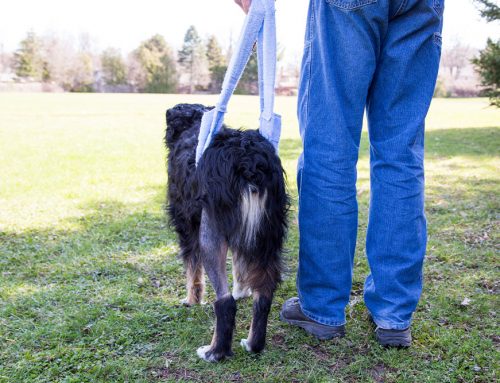
By the middle stage the back end has weakened and walks get shorter, but there’s still real strength to support. A support harness does its best work here, giving you a handle to steady a pet up from the floor and through stairs without doing the walking for them.
The right style depends on where the trouble sits:
- Weak in the rear: A rear-support harness cradles the hips and adds a handle to lift the back end through stairs, curbs, and the effort of standing up. This is the common picture: strong up front, failing behind.
- Weak in front or in more than one leg: A full-body support harness lifts the front and rear together so a pet stays steady end to end instead of propped up at a single point. A front-support style covers a pet who’s mainly weak up front or favoring a front leg.
- Scuffing or dragging paws: A pair of knuckling socks shields the toes and helps guide the foot into a proper stance. Stretchy resistance bands can cue better foot placement while keeping the muscles working.
Fit matters more than brand, and a harness that rubs or sits wrong just adds a new problem on top of the old one. If your dog or cat is at this stage, book a fitting and we’ll match the style to where the trouble sits.
When Does a Senior Pet Need a Mobility Cart?
A cart earns its place when the rear legs can no longer hold weight or push off a step, and lifting with a harness has stopped being enough for either of you. Mobility carts for dogs hand a senior pet back the freedom to walk, sniff, and stay in the middle of the family’s day rather than watching from a bed in the corner.
A cart isn’t a last resort and it isn’t an all-day chair. It works best for active outings, with your pet out of it and resting comfortably in between. Introduce it over a week or two of short, upbeat sessions paired with treats and a favorite route, so it reads as an adventure rather than a contraption. Most dogs figure it out faster than their families expect.
Fit is less forgiving than it is with a harness. A frame sitting even slightly off can rub a pressure sore over a bony hip, so measurements should be taken carefully and rechecked as your pet’s weight and muscle mass change. Two other things matter once a pet spends more time lying down:
- Skin and bedding. Check the hips, elbows, and hocks regularly for red or thinning patches, and use thick padded bedding rather than a thin mat on a hard floor.
- Bladder and hygiene. Pets with advanced nerve disease may lose reliable bladder control, and urine left against the skin causes painful scalding. We’ll show you how to keep the area clean and dry, and how to help your pet empty the bladder if that becomes necessary.
Plenty of senior dogs go on to live full, busy lives on wheels, still first to the door when the leash comes out.
What Conditions Are Behind a Senior Pet’s Mobility Decline?
Naming the condition behind the change tells you how support will evolve over the months ahead. Arthritis is far and away the most common, but a handful of disc, nerve, and orthopedic problems show up in senior pets too, and each one bends the plan in its own direction.
| Condition | What’s happening | Typical support arc |
| Arthritis | Worn, painful joints, the most common cause | Traction aids harness for support, plus pain control and weight loss |
| Intervertebral disc disease | A slipped disc, often sudden rear-end weakness | Harness through recovery, carts for those with permanent nerve deficits |
| Degenerative myelopathy | A slow, progressive nerve disease | Support that climbs as it advances: traction support, harnesses, and eventually a cart |
| Hip dysplasia | Poorly formed, painful hips | Harness for rough moments, surgery for some |
| Post-amputation | Life on three legs after cancer or injury | Harness for short-term help, and most adapt fast |
What Else Belongs in a Mobility Plan Besides a Device?
A harness or cart is one piece of the plan, never the whole thing, and the quieter pieces alongside it do at least as much of the work.
The pieces that matter most:
- Pain control: This ranges from anti-inflammatories to monoclonal antibody injections such as Librela for dogs and Solensia for cats, plus other medications matched to the underlying cause. Comfortable joints move more, and movement is what keeps them working.
- Weight management: Trimming extra pounds eases every joint at once and often does more than any single product on this page.
- Joint nutrition: Supplements and omega fatty acids support cartilage and calm inflammation where they suit the case.
- Rehabilitation: Targeted exercises that rebuild strength and balance are the heart of veterinary physical rehabilitation. Our certified practitioner will develop a plan just for your pet that changes as they do. Our underwater treadmill is especially valuable for building muscle in pets with degenerative nerve disorders like IVDD and degenerative myelopathy. Between sessions, laser therapy can ease sore joints and support healing.
We’ve held AAHA accreditation continuously since 1957, and pain management is one of the areas evaluated at every inspection cycle, which is worth knowing when you’re weighing where to manage a condition that will need attention for years.
A senior pet’s needs shift over months, not years, so the plan is never one and done. Regular senior wellness checkups keep us a step ahead of the next stage instead of chasing it.
When Is a Sudden Mobility Change an Emergency?
Most senior mobility loss creeps in slowly, but a few changes are true emergencies. Sudden paralysis, a paw that knuckles under and stays folded, or a pet that can’t bear any weight can signal an acute spinal event, and they call for prompt evaluation rather than a wait-and-see night.
We take emergency cases during our open hours, and a quick call to say you’re on the way helps us be ready for you. If it happens after we’ve closed, head straight to the nearest veterinary emergency hospital, since an acute spinal problem is often most treatable in the first few hours.
Frequently Asked Questions About Senior Pet Mobility Aids
Will supporting my pet with a harness make their muscles weaker?
Used correctly, a harness supports movement rather than replacing it, so it doesn’t cause weakness. The idea is a steadying lift through the hard moments while your pet keeps using their own legs for everything they still can. Paired with rehabilitation and gentle activity, a harness helps build strength rather than letting it fade. The trouble only starts when a harness becomes a hammock and a pet stops trying to move on their own.
How do I know a harness or cart fits my pet right?
A good fit sits snug without rubbing, lets your pet move naturally, and leaves no red marks, raw spots, or chafing where the straps rest. If a harness slides around, pinches behind the legs, or your pet keeps trying to shake it off, the fit or the style is wrong for them. Carts need even more precision, since a frame that sits a hair off can rub a pressure sore over a bony hip. It’s worth having us size and adjust one rather than guessing from a chart.
Do mobility aids help cats, or are they really just for dogs?
Cats benefit just as much, though the toolkit leans differently. Most senior cats do beautifully with traction and thoughtful home changes. Support harnesses sized for cats exist and help some, and a few cats even take to a cart. Because cats hide pain so well, the bigger challenge is usually noticing the trouble early.
How do I know whether we’re still helping or just prolonging things?
That question deserves an honest conversation rather than a rule. What we look at together is the everyday picture: whether your pet still eats with interest, still seeks out the family, still has more comfortable hours than uncomfortable ones, and whether the hard parts are manageable for your household. Plenty of pets have good months and even years left in a cart or a harness. We’ll tell you plainly what we see, and we’ll keep telling you as things change.
Keeping Your Senior Pet Moving in Syracuse
A slower senior pet doesn’t have to be a sidelined one. The right support for the stage, layered with the rest of the plan, keeps most dogs and cats comfortable and in the thick of family life far longer than you’d expect. If your senior dog or cat has started slipping on the floors or moving differently, reach out and we’ll help you sort out the stage and the plan. Thoughtful senior pet care is what keeps those good years rolling.


Leave A Comment